
Ancient Egypt: A Curiosity-Led Mini Unit Study for Ages 5–11
Ancient Egypt lasted more than three thousand years. You will not cover all of it in a fortnight. This unit study isn't trying to. It's a two- to three-week curiosity-led exploration for a child aged 5 to 11 — six short mini-lessons, around thirty minutes a day, organised by theme rather than by chronology. Pick the ones that pull your child first. Skip the ones that don't. The point is curiosity, not coverage.
What this is (and what it isn't)
This is a curiosity-led mini unit study. A parent-led exploration of ancient Egypt that follows your child's questions rather than a fixed syllabus. It's organised so you can read it through in order, or pick whichever mini-lesson catches your child's attention first and start there.
It isn't a curriculum. There are no worksheets. There are no assessments. There is no grade level it lines up with. It is designed to slot in alongside whatever else your week looks like — school, learning at home, or somewhere in between — not replace any of it.
It is also not exhaustive. Egyptian civilisation lasted longer than the time between the building of the pyramids and the founding of Rome. Three weeks is a pinhole through which to look at it. The honest goal is not "your child will know ancient Egypt" — it's "your child will want to know more."
How to use this
Each mini-lesson takes about thirty minutes. There are six of them. Done in order across two to three weeks, that's roughly two mini-lessons a week — comfortable, not demanding. Done out of order, by what catches the child first, it works just as well.
Each mini-lesson has the same shape: a short direct answer up top, two or three paragraphs of substance, a single read-aloud line, and one question to ask your child afterwards. Read the substance to yourself first; share what feels worth sharing with your child. Trust your sense of what they're ready for.
You don't need books, materials, or a quiet room. You need thirty minutes and a willingness to sit with the questions.
Geography — the Nile and the desert
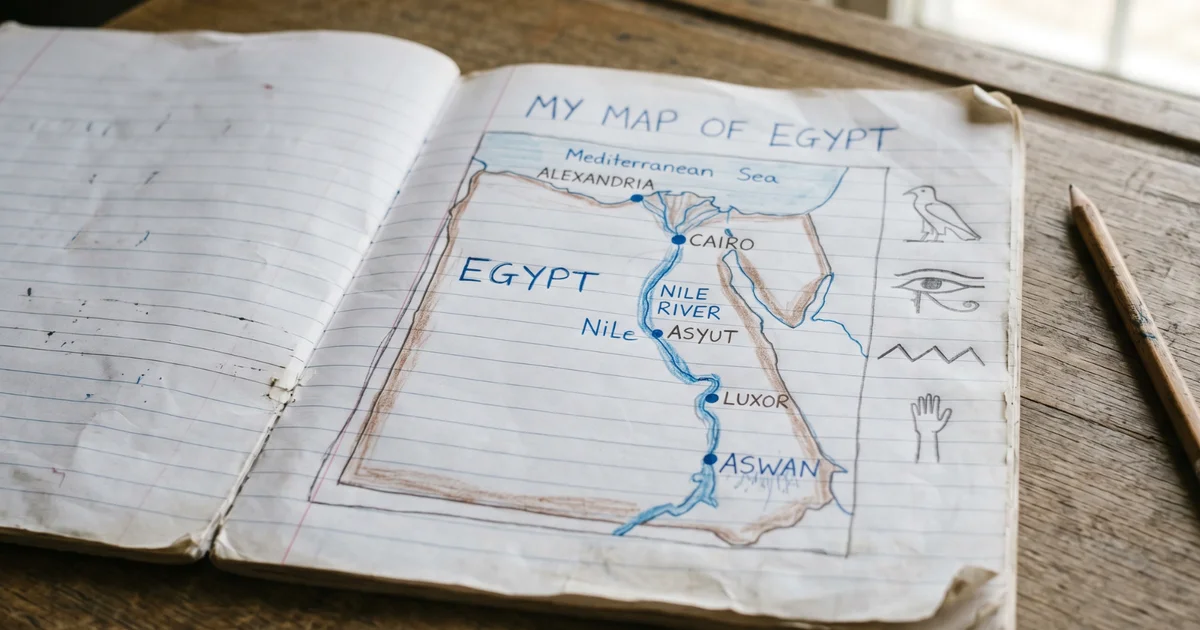
Egypt is one of the least geographical countries in the world: a thin green ribbon of farmland along a single river, in the middle of an enormous desert. Without the Nile, no civilisation. Most of what made ancient Egypt possible can be traced to the river that flooded reliably, every summer, for thousands of years.
The flood season — called Akhet — ran from roughly June to October. The water rose, covered the fields, and then, as it withdrew, left behind a thick layer of fertile black silt. The Egyptians called their country Kemet — the "black land" — for the colour of that soil (Nat Geo Kids). Beyond the silt strip on either side of the river: red desert that nothing grew in.

The Egyptians divided the country into two: Upper Egypt (the southern part, upstream, with the river running northward) and Lower Egypt (the northern delta, where the Nile fanned into the Mediterranean). The country was unified around 3100 BCE by a king called Narmer. The double crown the pharaohs wore — red and white — represented those two kingdoms joined as one (https://www.metmuseum.org/perspectives/ancient-egypt-board-games).
"The desert wasn't far away. From the edge of any farmer's field, if you walked twenty minutes, the green disappeared and there was nothing but sand. Egypt was the river and the land it watered. Everything else was empty."
If your whole country depended on one river flooding every summer, how would that change the way you celebrated, prayed, or kept time?
People — pharaohs and farmers
Most ancient Egyptians were farmers. Pharaohs were the famous ones, but the country was held up by the thousands of ordinary people who grew the food, hauled the stones, baked the bread, and raised the children. The pharaohs we remember by name; the farmers we know about because they left their houses, their tombs, and their tools behind.
A pharaoh was considered a sort of bridge between the gods and the people. Egyptians believed the pharaoh's rule kept the cosmic order — ma'at — in balance. Most pharaohs were men; some, like Hatshepsut, were women. Hatshepsut ruled for about twenty-one years during the New Kingdom (~1540–1075 BCE), built one of Egypt's most beautiful temples at Deir el-Bahri, and was a successful trader as well as a builder (Nat Geo Kids).

Below the pharaoh, Egyptian society had priests, scribes (the people who could read and write), soldiers, craftsmen, traders, and — by far the largest group — farmers. Women in ancient Egypt had unusually strong rights for their time: they could own property, run businesses, and serve as scribes, priests, and doctors. Most ordinary people lived in mud-brick houses, often built in clusters near the Nile, on land just high enough to escape the flood.
"If you walked through an Egyptian village four thousand years ago, most of the people you'd meet would be farmers — and most of those farmers would have known the pharaoh's name but never seen his face."
Why do you think we remember the pharaohs and forget the farmers, when there were so many more farmers?
Story — the myth of Isis and Osiris
Every ancient civilisation had a story it told about itself — a foundational story. For the ancient Egyptians, the most important was the myth of Isis and Osiris. It's a story about death, love, magic, and the return of life — and it shaped everything from how Egyptians prepared for the afterlife to why they buried their dead the way they did.
A note before you tell this story: it is a myth. The ancient Egyptians believed in it as part of their religion, the same way different communities today hold sacred stories. We tell it here as a story they told — not as history. Make that distinction clear with older children especially.
The story (a simplified version, drawn from Britannica Kids and the Wikipedia summary of the Osiris myth): Osiris was the eldest god and the first king of Egypt. He married his sister Isis, who was beautiful, wise, and skilled in powerful magic. Osiris ruled well, and the people loved him. But Osiris had a brother — Seth, the god of storms and disorder — and Seth was jealous. Seth tricked Osiris into climbing into a wooden box he had made to fit Osiris exactly. Once Osiris was inside, Seth slammed the lid shut and threw the box into the Nile, where it drifted out to sea. Isis searched the world for her husband and finally found the box. She brought it home and, using her magic, she returned Osiris to life — but not to the world of the living. Osiris became lord of the underworld instead, where he received and judged the souls of the dead. Isis and Osiris had a son, Horus, the hawk-god, who would one day fight Seth for the throne of Egypt.
"When Isis found the box, she did not open it for a long time. She just sat beside it and wept."
What do you think the Egyptians were trying to explain when they told this story? (Older children may notice: the Nile flooding, the death and return of crops, the cycle of life and death.)
Writing — hieroglyphs and the Rosetta Stone
The ancient Egyptians wrote with more than 700 picture-symbols called hieroglyphs. A single hieroglyph could represent a sound, a word, or an idea, depending on context. This made the writing system rich but also difficult — and when the civilisation ended, hieroglyphs went unread for more than a thousand years.
Hieroglyphs were carved on temples and tombs (the sacred script), but Egyptians also used simpler, faster scripts for everyday writing — hieratic (a kind of cursive hieroglyph for priests and scribes), and later demotic (everyday script for ordinary documents). After the Roman Empire took over Egypt and Christianity spread, the old scripts gradually fell out of use. The last known hieroglyphic inscription dates from around 394 CE (Wikipedia — Egyptian hieroglyphs). After that, the meaning was lost.
For nearly fifteen hundred years, no one could read a word of it. Then, in 1799, French soldiers in Egypt found a black stone slab with the same royal decree carved on it three times — in hieroglyphs, demotic Egyptian, and ancient Greek. That slab became known as the Rosetta Stone. A French scholar named Jean-François Champollion spent years working on it, and on 27 September 1822 he announced he could read the hieroglyphs (Britannica). It opened ancient Egypt back up to history.

The Rosetta Stone is in the British Museum today. They have it photographed in detail online — you can show your child the actual three scripts and let them try to guess which is which.
"For a thousand years, the temples still stood and the writing was still there, but no one alive could read it. Imagine knowing a whole library existed and not being able to open a single book."
If you wanted to send a message to someone four thousand years in the future, how would you do it?
Daily life — cats, food, games, and clothes
The Egyptians left so many of their belongings in tombs that we know a great deal about how they actually lived. They kept cats and dogs. They wore white linen. They played board games. They drank beer with breakfast. They painted their eyes black with kohl — boys, girls, men, and women alike. They were people, not myths.
Cats were among the most loved animals in Egypt. They were sometimes mummified alongside their owners. The goddess Bastet, who was depicted as a cat or a cat-headed woman, had her own great temple at the city of Bubastis, and ordinary families travelled to it on pilgrimage (Nat Geo Kids).

Food. Most Egyptians ate bread (made from emmer wheat), beer, onions, garlic, dates, figs, fish from the Nile, and goat's milk. Meat — mostly poultry, beef, or sometimes game — was rarer, often saved for festivals. One Egyptian tomb contained a complete preserved meal: barley porridge, quail, kidneys, pigeon stew, fish, bread, and small circular cakes (Britannica Kids) — left there as food for the dead person to take into the afterlife.
Clothes. Linen was made from flax grown in Egyptian fields. Most people wore simple white tunics — practical in the heat. Wealthy Egyptians wore finer linen and gold jewellery; ordinary people wore plainer linen and beaded jewellery.
Games. The board game Senet was played for over two thousand years; another game called Mehen, played on a coiled-snake board, has been found in tombs over four thousand years old (Wikipedia — Mehen).
"The most surprising thing about ancient Egyptian children is that they would recognise some of your toys, your games, and even your meals. The differences are smaller than the centuries make them seem."
Which detail about how an Egyptian child lived surprises you the most?
Modern Egypt — from Cleopatra to today
Egypt did not end with the pharaohs. Ancient Egypt closed when the last pharaoh, Cleopatra VII, died in 30 BCE — but Egypt the country has continued, without a break, for more than two thousand years since. It has been Roman, Christian, Arab, Ottoman, briefly British, and is today an independent republic of around 120 million people.
After the Roman conquest, Egypt became a Christian country for several hundred years — and the Coptic Christian community there today traces its roots directly to that period. In the seventh century CE, Arab armies brought Islam, and Arabic became the dominant language. Egypt today is mostly Muslim, with a Coptic Christian minority estimated at around ten percent of the population (estimates range, since modern Egyptian censuses don't always record religion).
Cairo, Egypt's capital, sits near the Nile delta — not far from the pyramids of Giza. It is one of the largest cities in Africa, with a metro-area population of roughly 22 million people (Wikipedia — Greater Cairo). The official language is Arabic; English is widely understood. Modern Egyptian football, music, and food are part of the country's daily life — the pyramids are tourist sites for modern Egyptians too, not separate from them.

This is the part of Egypt most school resources skip. It's worth not skipping. The story of Egypt isn't only ancient.
"If you walked through Cairo today, you would see what every great city sees: traffic, schools, families, markets, cafés. The pyramids would be a forty-minute drive away. Modern Egyptians have ordinary lives and an extraordinary history — and the two belong to the same country."
Why do you think most books about Egypt stop at Cleopatra?
Books to read alongside this unit
These are recommended children's books on ancient Egypt — verified from independent booklists (Booktrust, BooksForTopics). Use them as supplements; you don't need all six.
Frequently asked questions about an Ancient Egypt unit study
How long does this unit take?
Two to three weeks at a comfortable pace — six mini-lessons of roughly thirty minutes each, done two or three times a week. You can stretch it longer if a lesson sparks a rabbit hole; you can do it faster if the curiosity carries. The number of weeks isn't the point.
Is this a homeschool curriculum?
No. It's a curiosity-led mini unit designed for any family with a curious child — whether they're at school full-time, learning at home, or somewhere in between. There are no worksheets, no assessments, no grade-level alignment. It supplements; it does not replace.
Do I need to follow the mini-lessons in order?
No. Pick whichever pulls your child first. Some children will want the myth before the geography; others will want the daily-life mini-lesson before they care about pharaohs. Follow the curiosity.
What age is this really for?
Five to eleven. Younger children focus on the vivid details — the cats, the kohl, the river — while older children handle the longer threads — the cracking of hieroglyphs, the political shape of the Old and New Kingdoms, the bridge to modern Egypt. The read-aloud lines work for both ends of the band.
Will my child need worksheets?
No. There are no worksheets in this unit. The "ask your child" questions at the end of each mini-lesson are the work. They are open-ended; there is no right answer. If your child wants to write, draw, or build something afterwards, let them — but it isn't required.
What if my child gets stuck on one mini-lesson?
Stay there. The point is curiosity, not coverage. A child who spends three days on Isis and Osiris has learned something worth more than a child who races through all six lessons in a week. Mini-lessons skipped on the first pass can be returned to later — or not.
—
EXPLORED ✓
This is one of the three pieces in our Cairo content cluster:
- Read the Cairo parent guide — what kids actually ask about Egypt, with sources
- Try the 5 read-aloud, discussion, and play ideas for kids exploring Egypt — 15–30 minute activities, no materials
- Visit the Chapter 1: Cairo resource hub — curated podcast, film, book, and museum resources
Curious about The Mailbox Club?
Read Chapter 1: Cairo completely free. A real letter from two siblings — posted to your child each month, telling the story of a different place in the world.
Read Chapter 1 free
Helen & Saul Wells-Lakeland
Helen is one half of the family behind The Mailbox Club, writing the monthly adventure letters that travel the world with curious kids.
More about The Mailbox Club →