
Teaching Kids About Egypt — A Curious Parent's Guide
Egypt is the place where curious children stop you mid-sentence and ask whether the pyramids are real, whether anyone still writes in hieroglyphs, and whether the Nile is actually a river or a stripe on a map. This guide is for the parent who wants to give better answers than "yes" and "no." It pulls together what kids ages 5 to 11 actually ask about Egypt, why those questions matter, and how to keep the curiosity going at home — no curriculum required.
Why Egypt matters for curious kidsWHY
EGYPT
✓
Ancient Egypt lasted more than 3,000 years — far longer than most of the great civilisations that came after it. That length is the first thing worth telling a child. The pyramids at Giza had already stood for over a thousand years before the city of Rome was founded, and they were still standing — already ancient — when Cleopatra was born.
For children, Egypt is one of the rare topics that grips both the youngest and the oldest at the same table. A five-year-old will gasp at the idea that cats were sacred and that families painted their eyes with black kohl, parents and children alike. An eleven-year-old will pause at the fact that no one could read a single hieroglyph for over a thousand years after the civilisation ended — until a French scholar named Jean-François Champollion cracked the code in 1822, using a stone slab carved with the same message in three different scripts.
Both of those facts are real. Both come from credible sources (National Geographic Kids, Britannica Kids). Neither needs a worksheet to land. That's what makes Egypt such a good destination to explore with your child: the stories do the work.
What kids ask about EgyptWHAT
KIDS
✓
These are the questions our research kept surfacing — drawn from search trends, parent forums, and curated kids' resources. They're a good map of where most children's curiosity actually goes. Pick the ones your child has been circling.
Who built the pyramids?
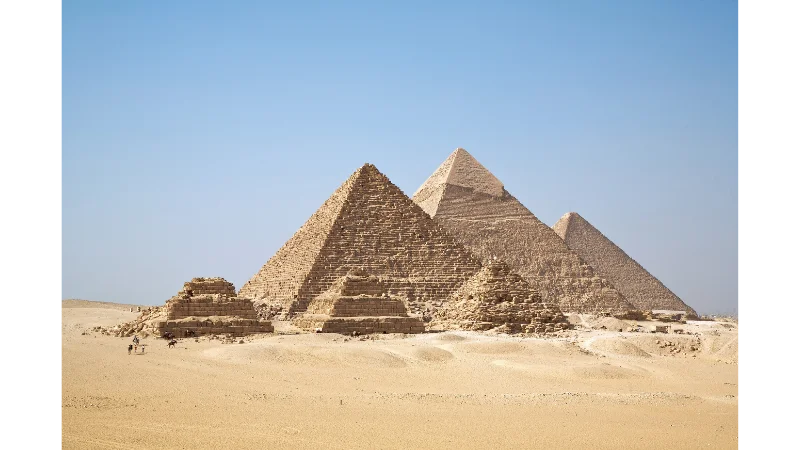
The three great pyramids at Giza were built for three pharaohs — Khufu, Khafra, and Menkaure — beginning around 2550 BCE, by tens of thousands of skilled Egyptian workers (not slaves, as older books sometimes claimed). The largest, Khufu's Great Pyramid, stands about 147 metres tall and is made of an estimated 2.5 million stone blocks, each one weighing between 2 and 30 tonnes (Britannica Kids).
For a five-year-old, the image to hold is this: each block is about as heavy as a small car. Stack two and a half million of them. For an eleven-year-old, the harder question is also the more interesting one: how did anyone move the blocks? Modern best guesses involve wooden sledges and dampened sand — when you wet the sand just enough, friction drops by half, and a 2014 study at the University of Amsterdam confirmed it experimentally (Physical Review Letters, April 2014). The pulling itself was done by a workforce that may have included up to 25,000 paid workers at any one time, fed and housed in nearby villages. We've found the villages — Mark Lehner's excavations at Giza uncovered the bakeries, breweries, and workers' cemeteries that proved it (Harvard Magazine).
How did ancient Egyptians write?
The Egyptian writing system used more than 700 hieroglyphs — picture-symbols that could stand for whole words, sounds, or ideas. A hieroglyph of a sun could mean the sun, the god Ra, the day, or simply the sound "r," depending on context (National Geographic Kids UK).
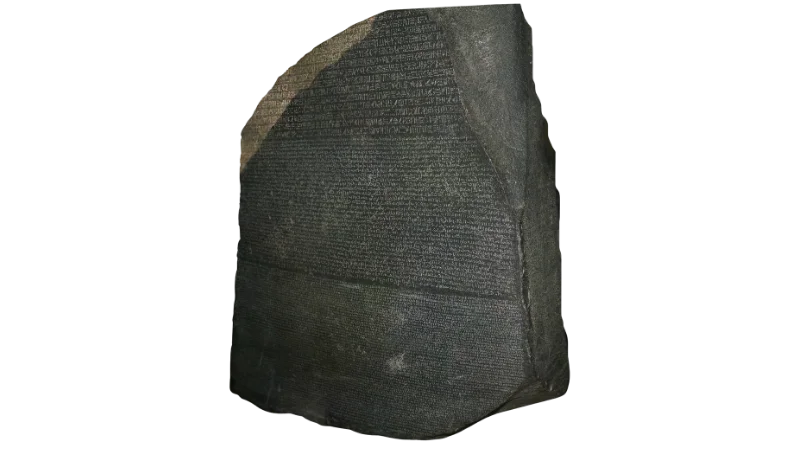
That ambiguity is why hieroglyphs were unreadable for more than a thousand years after Egypt's last pharaoh. Without a key, a picture-script is essentially a code. The Rosetta Stone — carved with the same royal decree in hieroglyphs, demotic Egyptian, and ancient Greek — was the key that let scholars finally translate.
For a child who likes codes, this is a brilliant rabbit-hole. The British Museum holds the Rosetta Stone, and they have it photographed in high resolution online.
What did Egyptian kids eat?
An archaeologist's discovery in one tomb included a complete meal preserved for the afterlife: barley porridge, quail, kidneys, pigeon stew, fish, bread, and small circular cakes. That tomb gives us a real menu, not a guess (Britannica Kids).
Most ancient Egyptians were farmers who lived on bread, beer (for adults), onions, garlic, dates, figs, fish from the Nile, and goat's milk. Meat was rarer, mostly for festivals. Children helped with farming from a young age — but they also played. We know this because we've found their toys.
Why was the Nile so important?
The Nile flooded every year between June and October, leaving a thick layer of dark, fertile silt that made farming possible in a land that is otherwise mostly desert. The ancient Egyptians called their country Kemet — the "black land" — for the colour of that soil (Nat Geo Kids).
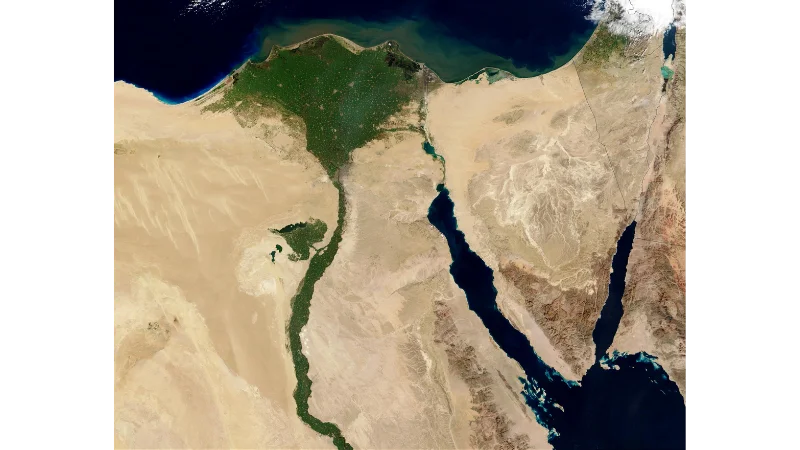
Without the Nile, no Egypt. The yearly flood was so dependable that Egyptians built their calendar around it: three seasons — flood, planting, harvest — each four months long. When a child asks why ancient Egypt happened there, the Nile is the whole answer.
Did Egyptian kids have pets?
Yes. Cats were the most famous — considered sacred, kept as family pets, and often mummified alongside their owners. Dogs were common too, especially for hunting and guarding. Some families kept geese, monkeys, or even hyenas (Nat Geo Kids UK).
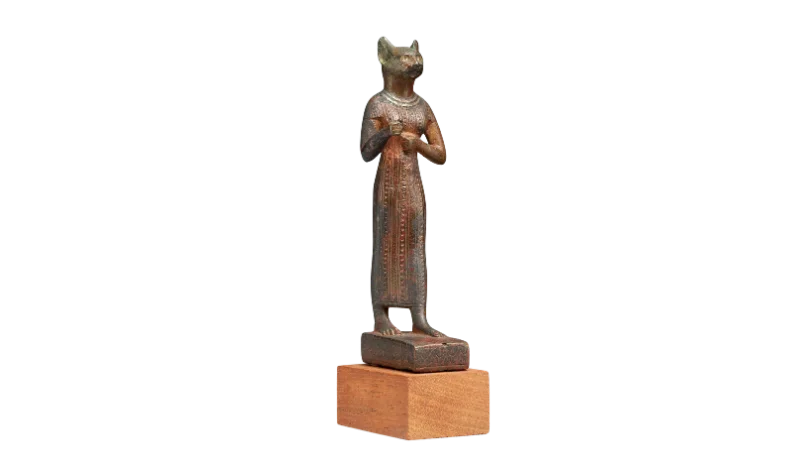
For a younger child, this is often the moment Egypt becomes real. They had cats. The cats had names. Bastet, the cat-headed goddess, was one of the most popular deities in the country — there were temples to her that ordinary families visited.
Are there still pharaohs today?
No — Egypt's last pharaoh, Cleopatra VII, died in 30 BCE, and the country has been ruled by Romans, Arab caliphs, Ottomans, and (briefly) the British since. Modern Egypt is a republic of around 120 million people. The capital is still Cairo. The official language is Arabic.
This is an important question to handle carefully with older children, because the move from "ancient" to "modern" Egypt is where most resources go quiet. Egypt isn't a ruin — it's a living country, with its own music, food, and football leagues, and a deep continuous history. The pyramids are part of that country, not separate from it.
What did Egyptians do for fun?
Senet was Egypt's most popular board game — played for over 2,000 years, with thrown sticks used in place of dice (National Geographic Kids UK). Children played with carved wooden animals, leather balls, dolls with movable arms, and a kind of tug-of-war.
We know about Egyptian play because the things they buried with the dead included games and toys. A graveside tells you what people loved.
Key people, places, and stories you'll meetKEY
PEOPLE
✓
The chapter letter your child receives introduces some of these directly. Others are worth knowing as a parent in case the questions go further.
Ten names that come up again and again when kids explore Egypt. Tap a card to flip it.

The pharaoh whose Great Pyramid at Giza used around 2.5 million stone blocks — each as heavy as a small car. Built c. 2560 BCE.

Egypt's last pharaoh, died 30 BCE — she lived closer in time to the first moon landing than to the building of the pyramids.

Egypt's lifeline — its annual flood left dark, fertile silt that made farming possible in the desert.

The cat-headed goddess, hugely popular with ordinary families — harming a cat could be severely punished.

The sun god — ancient Egyptians believed he sailed across the sky in a boat every single day.

The jackal-headed god of mummification and the dead, who weighed hearts against a feather.

Egypt's writing system of 700+ symbols — unreadable for over a thousand years until Champollion cracked it in 1822.

The same decree in three scripts — the key that unlocked hieroglyphs. Now in the British Museum.

Egypt's most popular board game — played for more than 2,000 years.
TAP A CARD TO FLIP IT
How to explore Egypt with your childHOW
TO
✓
These are the things that work at home, for a curious child between five and eleven, without buying anything special.
Read the story before you teach the facts. Egypt's myths are more interesting than its dates. Read aloud the story of Isis and Osiris (Anubis and the underworld), or the legend of how the cat-goddess Bastet protected the sun. Don't worry about historical accuracy first — children remember stories, then go looking for the facts.
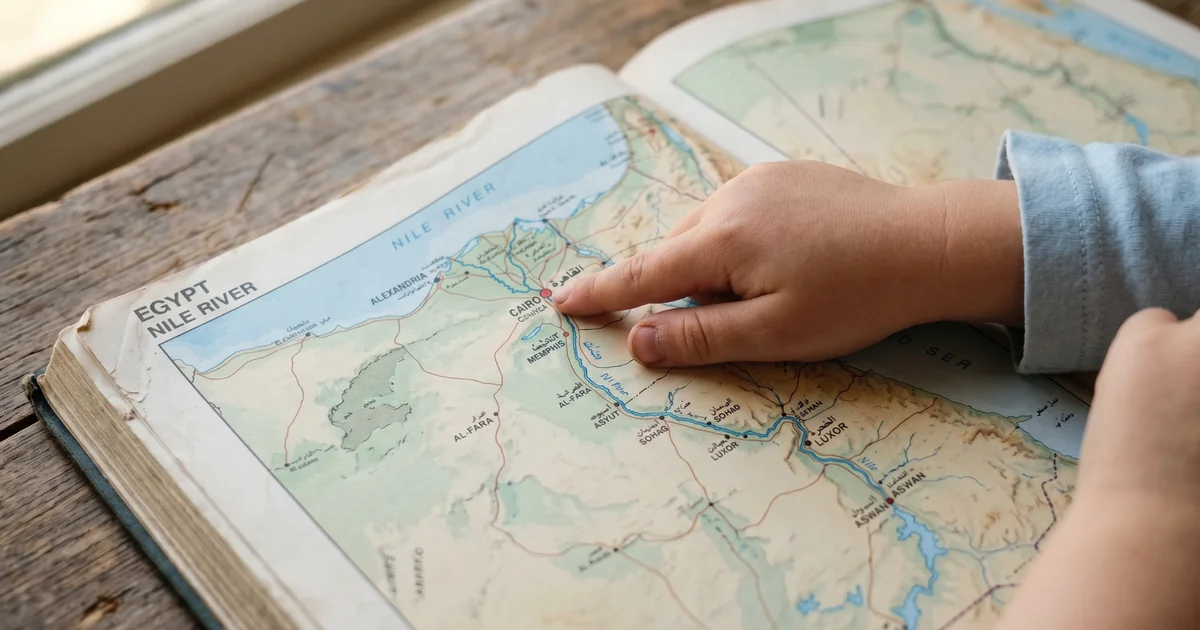
Use a real map. Trace the Nile with a finger. Show your child that ancient Egypt was a thin green ribbon along a river in the middle of a desert. The shape of the country is part of the story.
Find the British Museum online. The Rosetta Stone, the colossal head of Ramesses II, and the Gallery of Ancient Egypt are all photographed in good detail on the British Museum's website. For older kids, they have a free schools' resource on hieroglyphs that's better than most textbooks.
Watch one thing together. A 20-minute documentary clip is often enough. National Geographic Kids and BBC Bitesize both have short Egypt videos appropriate for ages 5 to 11.
Then ask better questions. "What do you think the kids who built the pyramids were doing while their parents worked?" beats "What is a pyramid?" by a mile.
Every claim above is checked against the sources linked throughout this guide — perfect dinner-table ammunition.
Frequently asked questions about teaching kids about EgyptFREQUENTLY
ASKED
✓
What age is ancient Egypt appropriate for?
Ancient Egypt works well for children from about age 5 upwards. Younger children focus on the vivid details — the cats, the eyeliner, the giant blocks — while older children (ages 8 to 11) can handle the longer story: how the civilisation lasted three thousand years, how it ended, and how the writing was deciphered. The themes are family-safe; the topic of mummification is usually less frightening to children than parents expect.
What's the best way to start teaching my child about Egypt?
Start with a story, not a fact. The myth of Isis searching for Osiris, or the simple narrative of "the Nile flooded every year and that's how everything worked" — these stick. Once your child is interested, the facts find their own way in. Avoid leading with a timeline or a worksheet; both are easier to remember once a child already cares.
Do I need to be a history teacher to do this?
No. Most parents don't know the difference between the Old, Middle, and New Kingdoms either, and you don't need to. The goal is curiosity, not exam performance. Read alongside your child, look things up together when they ask, and let them lead the rabbit holes. That's the whole method.
Is this a curriculum or a syllabus?
No — this guide is for any family with a curious child, whether they're at school full-time, learning at home, or somewhere in between. It's designed to slot in around whatever else your week looks like, not replace what's already working.
What if my child asks about mummies in a way that worries them?
Most children find mummies less alarming than parents expect — it helps to frame mummification as care, not horror. The ancient Egyptians believed that preserving the body let the person continue in the afterlife with their family. That's a thoughtful, sad idea, not a scary one. If your child is worried, focus on the why (love, hope, continuation) rather than the how.
Where can I find good books about Egypt for kids ages 5 to 11?
For a single first pick suitable for the whole age range, A Child's Introduction to Egyptology by Heather Alexander is well-organised, accurate, and engaging. For younger children specifically, Usborne's See Inside Ancient Egypt lift-the-flap book is a strong start. Our Ancient Egypt unit study has a fuller booklist.
What's nextWHAT'S
NEXT
✓
This is the hub of our Cairo content cluster. From here:
- Try our 5 read-aloud, discussion, and play ideas for kids exploring Egypt — 15–30 minute activities, no materials
- Explore our curiosity-led mini unit study: Ancient Egypt for ages 5 to 11 — six mini-lessons across two to three weeks
- Visit the Chapter 1: Cairo resource hub — curated podcast episodes, films, books, and museums for going deeper
Chapter 1: Cairo is completely free — a real letter and adventure pack your child can hold, posted to your door.
EXPLORED ✓
Curious about The Mailbox Club?
Read Chapter 1: Cairo completely free. A real letter from two siblings — posted to your child each month, telling the story of a different place in the world.
Read Chapter 1 free
Helen & Saul Wells-Lakeland
Helen is one half of the family behind The Mailbox Club, writing the monthly adventure letters that travel the world with curious kids.
More about The Mailbox Club →