
5 Read-Aloud, Discussion, and Play Ideas for Kids Exploring Egypt
Five no-craft, no-photo Egypt activities for kids ages 5 to 11 — read-aloud, discussion, listening, play. 15–30 minutes each. Nothing to buy.
The best activities for a curious child don't need glue or glitter or a craft cupboard. They need a vivid story, a question worth asking, and an adult who's willing to follow the rabbit hole. Here are five no-craft, no-photo activities for exploring Egypt with a child aged 5 to 11 — each one takes 15 to 30 minutes, uses nothing more than what you already have at home, and works whether you've read the chapter letter from Max and McKenzie or are starting from scratch.
Why these kinds of activities work
Children remember what they were emotionally curious about — not what they were quizzed on. The activities below lean on the things ancient Egypt does best: vivid sensory details, real human questions, stories you couldn't make up. None of them ask your child to produce a finished object. All of them ask your child to wonder.
If your child has already read Chapter 1 of The Mailbox Club's letter from Cairo, these will deepen what's there. If not, they're a strong way in.
What's next
This is one of the three pieces in our Cairo content cluster. From here:
- Read the Cairo parent guide — what kids actually ask about Egypt, with sources
- Try the curiosity-led mini unit study: Ancient Egypt for ages 5 to 11 — a two- to three-week curiosity exploration
- Visit the Chapter 1: Cairo resource hub — podcast episodes, films, books, and museums for going deeper
Each activity card has an Ages 5–7 / Ages 8–11 switch.
the story of the Nile flood
What it is. A two-minute read-aloud about the river that built Egypt. The Nile flooded every year, between June and October, leaving behind a layer of black, fertile silt. Without that flood, no farming. Without farming, no civilisation. The whole country watched for it.
Every June, the Egyptians watched the river. It always rose. They knew it would — they had watched it rise every summer for thousands of years. But they watched anyway, because if one summer it didn't, no crops would grow, and people would go hungry. By July, the river had spread across the edge of the farmland. By August, the fields had vanished — they were part of the river now, and people moved between villages by boat. By September, the flood was at its highest. And by October, the water had drawn back, leaving the whole valley shining with thick, dark, fertile mud. The Egyptians called their country Kemet — the black land — for the colour of that soil.
*What do you think the children did while the fields were underwater?*
Show them on a map how thin the green strip of farmland was — Egypt is mostly desert, and the Nile was a thin ribbon of life through the middle.
the sound of a sistrum
What it is. The sistrum was an ancient Egyptian sacred rattle, used in the temples of the goddesses Hathor and Isis. It was a U-shaped metal frame with sliding crossbars that jingled when shaken. Its sound was said to imitate papyrus stalks shaken in the wind — a kind of metallic, watery hiss. ([Britannica — Sistrum](https://www.britannica.com/art/sistrum))
What to do. Search "Egyptian sistrum sound" together on YouTube and listen to a 30-second recording. Multiple museums and music historians have posted recordings; you only need one. Listen with your child *without* showing them what the instrument looks like first. Ask them: *What do you think makes that sound? An animal? A weather event? An instrument?* Then show them what a sistrum actually is — a real photo from a museum collection is easy to find.
*Why might Egyptians have wanted music to sound like reeds blowing in the wind?*
Hand them a tin of dry rice and let them shake it gently — that's not far off how it sounds.
what would you take with you for the afterlife?
What it is. Ancient Egyptians believed that the things you were buried with travelled with you into the afterlife. Wealthy people were buried with furniture, games, food, jewellery, and sometimes their pet cats. Ordinary people were buried with more modest things — a comb, a small jar of beer, a favourite figurine. Archaeologists know what people ate, played with, and loved because of what they buried with their dead.
What to discuss. Ask your child: *If you were going to be buried with three things — anything at all — what would they be? And what would those three things tell someone four thousand years from now about who you were?*
This is a thoughtful conversation, not a morbid one. Egyptian mummification was an act of love and hope: the family believed the person they cared about was continuing, and wanted them well-equipped.
*What do you think would have been the hardest thing for an Egyptian child to choose?*
Stick to favourites — their stuffed animal, their favourite drawing, a photo of the family.
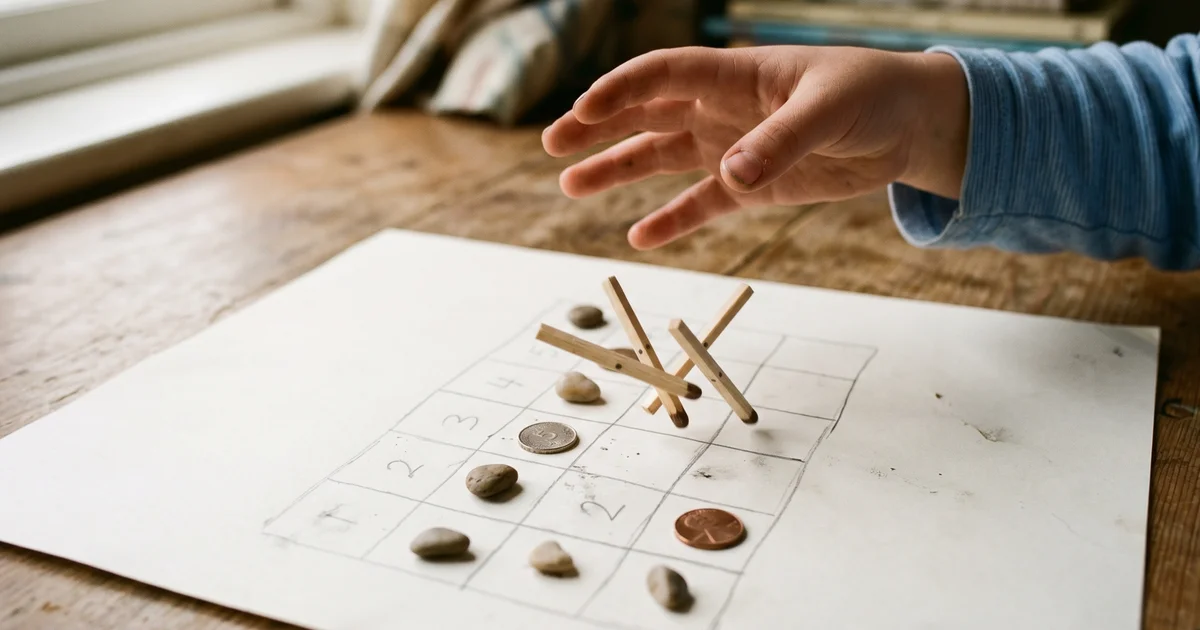
Senet, the 4,500-year-old board game
What it is. Senet is the oldest board game we still have evidence of. The earliest known board dates to around 2620 BCE — which means children were playing it at the same time the Great Pyramid was being built. The board is a 3-row by 10-column grid: 30 squares in total. Two players, five pieces each, four casting sticks used in place of dice. You move along a zig-zag path from square 1 to square 30, with special "good" squares and "hazard" squares along the way ([Wikipedia — Senet](https://en.wikipedia.org/wiki/Senet); [Met Museum — Senet and Twenty Squares](https://www.metmuseum.org/perspectives/ancient-egypt-board-games)).
| 1 | 2 | 3 | 4 | 5 | 6 | 7 | 8 | 9 | 10 |
| 20 | 19 | 18 | 17 | 16 | 15 | 14 | 13 | 12 | 11 |
| 21 | 22 | 23 | 24 | 25 | ✦ 26 | 𓂀 27 | 𓆄 28 | 29 | 30 |
The board to copy — a 3×10 grid, played in a zig-zag from square 1 to 30.
What to do. Sketch a 3×10 grid on any sheet of paper — that's the board. Use five pebbles, beads, or coins for each player. Use four flat sticks (matchsticks, coffee stirrers, anything similar) — mark one side of each. The number of marked sides facing up when you throw them is how many squares you move.
An honest note for older kids. The original rules of Senet were lost during the Roman period. The rules people play with today are a careful historical reconstruction, based on tomb paintings and surviving texts (Wikipedia — Senet). It's a reminder that even something as fun as a board game can be a real piece of detective work for historians.
*Why do you think the rules got lost? And how would you go about reconstructing them today?*
Just play "race to the end" — first to get all five pieces off the board wins. Skip the special squares.
what would you write back to Max and McKenzie?
What it is. Max and McKenzie are the two sibling characters who write home in every Mailbox Club letter. The first letter, Chapter 1: Cairo, is from them — describing what they're seeing, what they don't understand yet, what they want their family to know.
What to do. After your child has read the Cairo letter, ask them what they'd write back. Not a school assignment — just a question. *If Max and McKenzie sent you that letter, what would you want to tell them? What would you ask?*
If they're old enough to write, hand them a sheet of paper. If they're younger, write it for them as they dictate. The answer doesn't need to be sent anywhere. The act of replying is the point.
*What do you think Max and McKenzie don't know yet about Egypt that you could tell them?*
Help them draw a picture instead — what would they want Max and McKenzie to see?
Frequently asked questions about Egypt activities for kids
How long does each activity take?
Most of these take 15 to 30 minutes — short enough to do at the kitchen table after school, long enough to feel like a proper exploration. Senet, if you get into it, can take longer; the others are quick.
What age are these for?
Five to eleven, with younger and older variations included for each activity. The reading levels stretch upward and the discussion prompts go deeper for older children, so the same activity can serve both a five-year-old and an eleven-year-old in the same family.
Do I need any materials?
No. Every activity uses things you'll already have at home — paper, pebbles or coins, matchsticks or coffee stirrers, a device for one short YouTube clip. There is nothing to buy.
Can I do these without reading the Cairo letter first?
Yes. The letter from Max and McKenzie adds a layer of story to Activity 5, but every activity works as a standalone. If your child later receives the letter, the activities will deepen what's there. If not, they'll still work as a way into Egypt.
What if my child gets stuck on a question?
That's the activity working, not failing. The whole point is to slow down and wonder. Sit with the question. Offer one of your own. Let the silence happen. Curiosity grows in those pauses.
—
EXPLORED ✓
Curious about The Mailbox Club?
Read Chapter 1: Cairo completely free. A real letter from two siblings — posted to your child each month, telling the story of a different place in the world.
Read Chapter 1 free
Helen & Saul Wells-Lakeland
Helen is one half of the family behind The Mailbox Club, writing the monthly adventure letters that travel the world with curious kids.
More about The Mailbox Club →